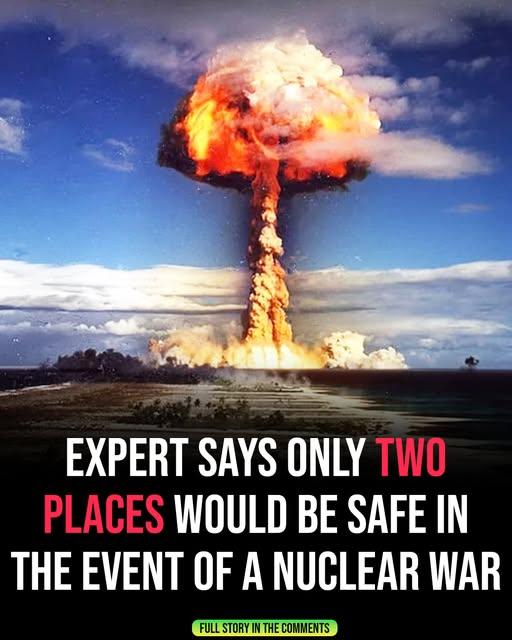
As U.S. and Israeli warplanes rain destruction across Iranian cities, an unsettling, almost whispered question has begun to creep into American homes: where would you go when the sirens sound? The echoes of the Cold War feel eerily familiar, yet the stakes now are unimaginable. The weapons are faster, more precise, and more devastating. The maps on your screen no longer just show borders—they outline the geography of survival and annihilation. Some states might look safer at first glance, but the illusion dissolves with even the slightest scrutiny. What once seemed like “safe ground” evaporates under the cold, harsh arithmetic of modern warfare.
Americans searching for “safe states” in a nuclear World War III quickly realize that this is not a matter of cartography—it’s a confrontation with a brutal truth: there is no true escape. Missile fields planted across the heartland would almost certainly become the first targets. Vast swathes of Montana, Wyoming, Colorado, Nebraska, and the Dakotas could turn overnight into radioactive wastelands, regions sacrificed in the calculus of deterrence and retaliation. Sophisticated models may highlight pockets with slightly lower projected fallout, and some East Coast or Midwest locations might theoretically avoid the initial firestorm. Yet even these relative refuges would face a cascading nightmare: failing electrical grids, poisoned water and food supplies, collapsing hospitals, and the creeping, inescapable threat of radiation sickness. Safety in this scenario is never absolute; it is provisional, fragile, and profoundly uncertain.
The longer-term consequences paint an even more harrowing picture. A full-scale nuclear exchange would not merely redraw political maps—it could reshape the very climate. Soot and ash thrown into the upper atmosphere could darken skies worldwide, plunging agricultural regions into years of unending winter and famine. Countries far removed from the immediate blasts would not escape the devastation: hunger, economic collapse, and mass displacement would ripple across continents. Even places like Australia and New Zealand, often cited as potential sanctuaries, would face the fallout of a broken global system—scarcity, societal upheaval, and a world forever altered by nuclear fire.
In the end, the search for a “safe zone” is a hollow exercise if these weapons are ever deployed. True safety is not a matter of geography, maps, or meteorological models—it is a political choice, a responsibility borne by leaders and citizens alike. The question is not where we run, but whether we can prevent the need to run at all. And that decision, made in conference rooms and on diplomatic tables, will define the survival of generations to come.