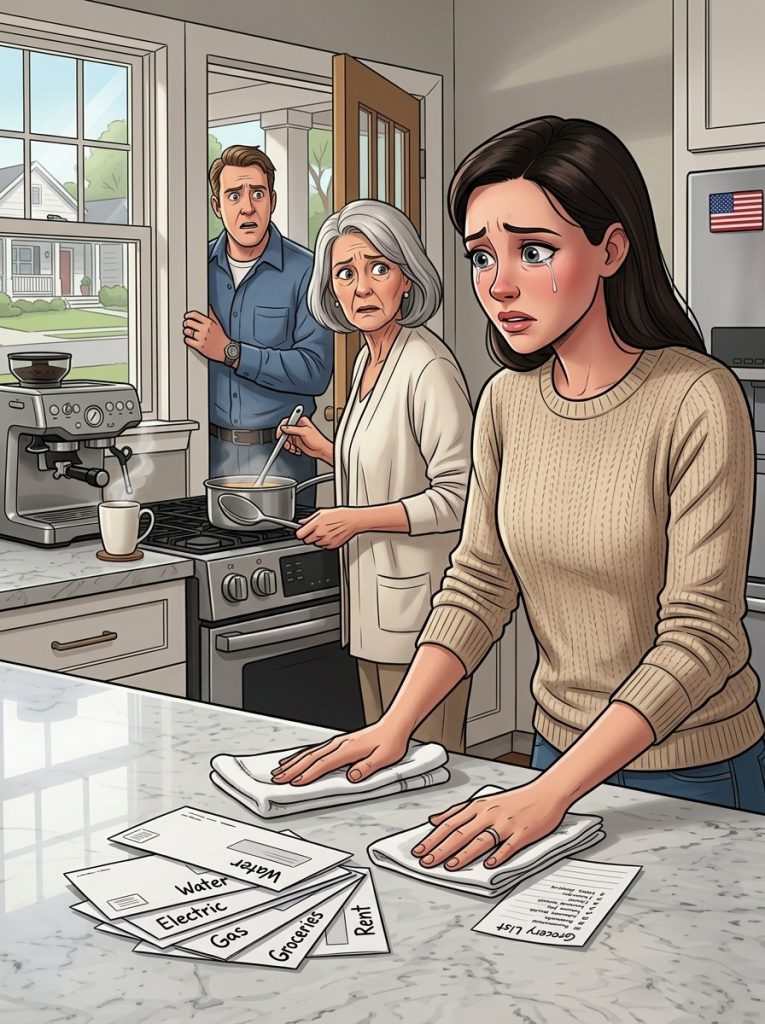
Just two days after our wedding, I refused to bring dinner to my sister-in-law while she sat glued to the television. My husband exploded, screamed at me, and slapped me across the face. Without thinking twice, I shoved the food away, and that single moment changed everything.
Two days after my wedding, I learned that a marriage could transform before the flowers from the reception tables had even begun to wilt.
My name is Emily Harper, and I married Daniel Whitmore on a bright Saturday afternoon in Portland, Oregon. He was thirty-two, polished, charming, the kind of man who remembered servers’ names and opened car doors when people were watching. His younger sister, Vanessa, was twenty-seven and had been living with him “temporarily” for nearly a year.
Before the wedding, Daniel told me Vanessa was fragile. “She’s been through a lot,” he said. “Just be patient with her.”
I tried.
I truly did.
On Monday evening, I came home from work with sore feet, still wearing the blouse I had worn to orientation at my new job. Daniel had texted me a grocery list during lunch, then called twice to remind me that Vanessa liked her mashed potatoes “extra buttery.” When I opened the front door, the television was blaring some reality show. Vanessa was curled up on the couch beneath a blanket, scrolling through her phone while laughing at the screen.
The kitchen sink was full. Empty soda cans covered the coffee table. Daniel stood near the counter with his arms folded, as if he had been waiting for a servant.
“You’re late,” he said.
“It’s 6:20,” I replied carefully. “Traffic was bad.”
Vanessa did not look away from the TV. “I’m starving.”
I cooked anyway. Chicken, potatoes, green beans. I plated everything and set two dishes on the dining table. Daniel sat down. Vanessa stayed on the couch, her eyes fixed on the screen.
“Dinner’s ready,” I said.
“Bring it here,” Vanessa said, waving one hand without turning around.
I stared at her. “You can eat at the table.”
The room went quiet except for the laughter coming from the television.
Daniel’s chair scraped back. “What did you just say?”
“I said she can eat at the table,” I answered. “I’m not serving dinner to someone glued to the TV like I’m hired help.”
Vanessa finally looked over, her face twisting. “Wow. Two days in and she already thinks she owns the place.”
Daniel crossed the room so quickly that I stepped back on instinct.
“Apologize,” he snapped.
“No.”
His hand struck my face before I even understood he had moved. A sharp burst of pain exploded across my cheek. My ear rang. For one second, everything froze—the blue and white flashes from the television, Vanessa’s mouth slightly open, Daniel breathing hard in front of me.
Then something inside me snapped cleanly in two.
Without hesitation, I shoved the food away with force. Plates crashed onto the floor. Chicken slid across the tile. The bowl of green beans shattered near Daniel’s shoes.
I looked him directly in the eyes and said, “You just made the biggest mistake of your life.”
PART 2
Daniel stared at the broken dishes as though they offended him more than the slap had offended me.
For years afterward, I would remember that moment in fragments: the sting burning across my cheek, the smell of butter and garlic, Vanessa clutching the blanket against her chest, Daniel’s face shifting from rage to shock when he realized I was not crying.
He expected tears. He expected begging. He expected me to lower my eyes and apologize for embarrassing him in his own house.
Instead, I reached for my phone.
Daniel lunged toward me. “What are you doing?”
I stepped back and lifted the phone high. “Calling the police.”
Vanessa jumped up. “Are you insane? It was one slap.”
“One slap two days after the wedding,” I said, my voice shaking but clear. “That’s not a mistake. That’s a preview.”
Daniel’s expression changed again. The anger faded just enough for calculation to show. He softened his voice, using the same tone he had used with my parents at the rehearsal dinner.
“Emily,” he said, “don’t be dramatic. I lost my temper. You threw food everywhere.”
“You hit me first.”
“You humiliated my sister.”
“I asked her to sit at a table.”
Vanessa scoffed. “You came into our family acting like a queen.”
That sentence told me everything.
Our family. Not my home. Not our marriage. Their family, where I was supposed to earn my place by serving them.
Daniel took another step toward me. “Put the phone down.”
I dialed 911.
His eyes widened.
When the operator answered, I gave the address before Daniel could speak. I said my husband had slapped me across the face, that I did not feel safe, and that I wanted officers sent to the house. Daniel started talking over me, insisting I was emotional, newly married, stressed from wedding planning. Vanessa shouted that I had destroyed the kitchen.
The operator told me to move away from them if I could.
I grabbed my purse from the chair.
Daniel blocked the hallway.
“Move,” I said.
“You are not leaving this house like this.”
I looked at him, truly looked at him. This was the man who had danced with me two nights earlier beneath string lights, whispering that he would protect me forever. Now he stood between me and the front door, his jaw tight, his hand still red from hitting me.
“I am leaving,” I said. “And you will not touch me again.”
For one second, I thought he might.
Then headlights swept across the living room window.
Vanessa whispered, “You actually called them.”
“Yes,” I said. “I actually did.”
The police knocked hard. Daniel stepped aside with a curse under his breath. I opened the door before he could put on another version of himself.
Two officers entered. One spoke with me in the hallway while the other stayed with Daniel and Vanessa. I told the truth. I did not decorate it. I did not exaggerate. I said he yelled, slapped me, and tried to stop me from leaving. My cheek was already swelling.
Daniel told them I had “gone crazy” and thrown dinner.
The older officer looked at the broken plates, then at my face.
“Do you have somewhere safe to go tonight?” she asked.
I nodded. “My friend Rachel lives twenty minutes away.”
I packed a bag while the officer stood at the bedroom door. Daniel watched from the living room, silent now, his mask cracked but not completely gone.
As I zipped my suitcase, my wedding dress hung from the closet door inside its garment bag, white and useless.
I left my ring on the kitchen counter beside the pieces of shattered plate.
PART 3
Rachel Morgan opened her apartment door before I had even knocked twice.
She was thirty-one, a nurse, and the kind of woman who could read damage in a single glance. Her eyes went straight to my cheek. She did not gasp. She did not ask what I had done to cause it. She simply stepped aside and said, “Come in.”
That was the first kindness that made me cry.
I sat at her small kitchen table while she wrapped an ice pack in a towel. The apartment smelled like coffee and lavender detergent. Outside, Portland rain tapped softly against the windows, ordinary and calm, as though my life had not split open in the last hour.
Rachel placed the ice pack against my cheek.
“Did the police take a report?” she asked.
“Yes.”
“Good.”
Her voice was steady, but her hands trembled when she turned away to fill the kettle.
I stared down at my left hand. The pale mark where my ring had been looked strange, almost indecent. Two days married. Forty-eight hours. People still had not finished liking our wedding photos online, and I was sitting in my best friend’s apartment with a swollen face and a police report number in my purse.
My phone started buzzing at 9:14 p.m.
Daniel.
Then Daniel again.
Then Vanessa.
Then Daniel’s mother, Patricia.
Rachel looked at the screen. “Do not answer.”
“I know.”
But knowing and resisting were not the same thing.
The messages came in waves.
Daniel: You embarrassed me in front of my sister.
Daniel: I said I was sorry.
He had not said he was sorry.
Daniel: We need to talk like adults.
Vanessa: You are seriously ruining his life over one slap?
Patricia: Emily, marriage requires forgiveness. Call me.
Then Daniel sent a photo from our wedding. The two of us smiling beneath the arch, his hand around my waist, my face turned toward him like I had found safety.
Below it, he wrote: Don’t destroy this because you’re angry.
I turned the phone face down.
Rachel sat across from me. “Tomorrow, we go to the courthouse.”
I looked up. “For what?”
“A protective order, if you want one. And then a lawyer.”
The word lawyer sounded enormous. Bigger than divorce. Bigger than police. It sounded like a door closing.
“I don’t even know if an annulment is possible,” I said.
“Then we find out.”
I slept badly on Rachel’s couch. Every time a car passed outside, my body tightened. I replayed the moment over and over: Daniel’s hand, the sound, Vanessa’s face, the food hitting the floor. By morning, my cheek had darkened into a bruise no makeup could fully cover.
At 8:30 a.m., Rachel drove me to the courthouse.
I expected the building to feel dramatic, but it did not. It was gray, crowded, fluorescent, full of people holding folders and trying not to cry. A clerk gave me paperwork. I wrote Daniel’s name, my name, the address, the incident. My hand cramped from gripping the pen too tightly.
When I reached the section asking whether there had been threats or attempts to prevent me from leaving, I stopped.
Rachel touched my shoulder. “Write it.”
So I did.
By that afternoon, I had a temporary protective order. It was not a magic shield. It was paper. But it was paper that said the law had heard me.
The lawyer’s office was downtown, on the sixth floor of a building with narrow windows and quiet carpet. Her name was Marjorie Klein. She was in her fifties, sharp-eyed, calm, and direct.
She listened without interrupting. Then she asked for dates.
“Wedding was Saturday, June 14,” I said. “He hit me Monday, June 16.”
Her eyebrows lifted slightly, but her face stayed professional.
“Do you have witnesses?”
“His sister saw it.”
“Will she admit it?”
“No.”
“Any photos?”
Rachel had taken pictures of my cheek that morning in natural light. I handed them over. Marjorie studied them, then nodded once.
“Police report?”
I gave her the report number.
“Good,” she said. “Here is what we are going to do. We will file for divorce immediately. Annulment may be difficult depending on the grounds, but divorce is straightforward. You need distance, documentation, and no private contact.”
“No private contact,” I repeated.
“None. He will try different approaches. Anger, apology, guilt, romance, panic. Do not respond. Everything goes through counsel.”
She was right.
Daniel tried anger first.
He sent messages from new numbers after I blocked his. He said I had made him look like a criminal. He said his boss’s wife knew someone at the police department and rumors might spread. He said I was selfish, unstable, ungrateful.
